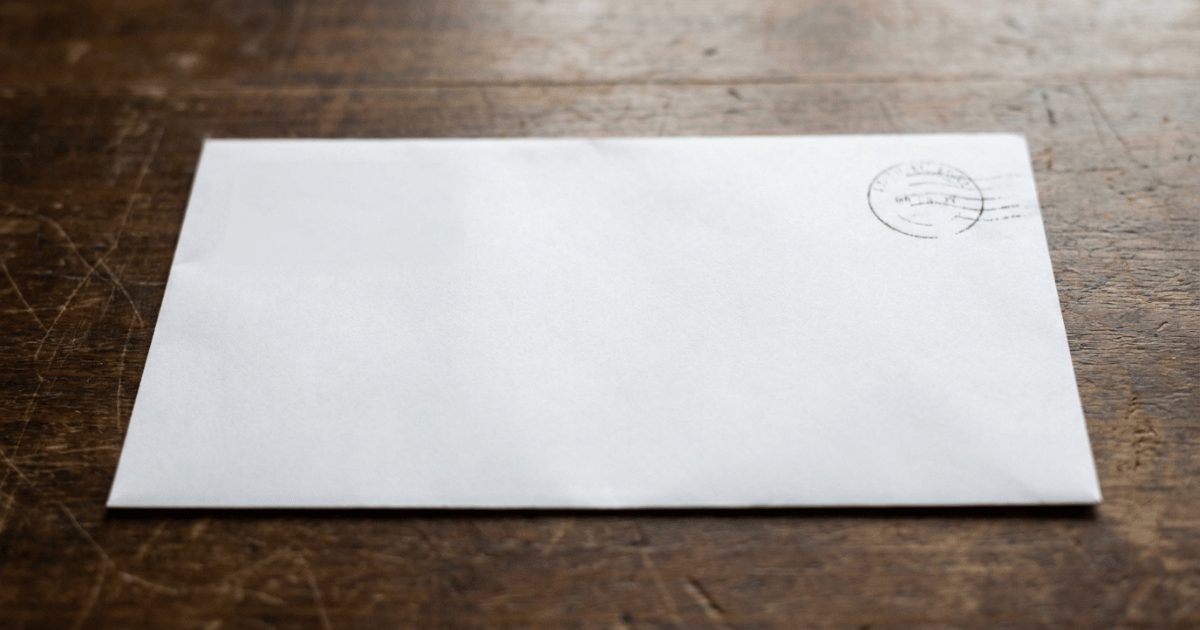
A return address is not required on ordinary domestic mail in the United States, so its absence is common rather than unusual. Political and advocacy campaigns, nonprofits, personal correspondence and plenty of routine mail arrive without one. The absence tells you almost nothing on its own. What matters is the combination: no return address plus a request for money, personal information or an urgent call is a different situation from no return address plus a greeting card.
Most of what is written about this answers the opposite question, which is whether you can send a letter without a return address. If you are holding one, here is what it actually means.
What USPS requires, and what it does not
USPS asks senders to include a return address but does not require one for standard domestic letter mail. It is required for certain services, such as items where the sender needs the piece returned or has bought extra services, but a plain stamped first class letter is accepted without one.
The practical consequence is the one that matters to you. Without a return address, an undeliverable item cannot be sent back to its sender, so it goes to the USPS Mail Recovery Center, the agency’s operation for mail that can be delivered to neither party. That is the entire postal significance of an empty upper left corner.
Senders who routinely leave it off
Four categories account for most no return address mail. Political campaigns, advocacy groups and voter contact programs, some of which omit it deliberately so a piece reads as personal rather than institutional. Personal letters, cards and invitations, where people simply do not bother. Bulk marketing entered under a permit, where the permit imprint near the stamp carries the mailing information instead. And window envelope mailings where the sender’s address sits inside the window with yours and is not printed separately on the outside.
Before concluding an envelope has no return address, check the back flap and check whether a permit imprint appears near the stamp. Those two places carry it more often than people expect, and reading what is there is covered in how to read a business return address.
When the absence actually matters
The missing address becomes meaningful only in combination with the contents. Three combinations are worth attention.
A request for money, a payment, or financial information from a sender who has given you no way to write back is a structural mismatch, because a genuine payee needs correspondence to reach it. An instruction to call a specific number, where that number is your only route to the sender, removes every independent verification path. And a claim of authority, meaning a letter presenting itself as a legal, governmental or official notice with no verifiable origin, is inconsistent with how agencies actually correspond.
In each case, the problem is not the blank corner. It is that the blank corner removes the checks you would otherwise run, which is exactly why it was left blank.
When it is worth treating seriously
Threatening, harassing or frightening content in unidentified mail is a different matter from an unfamiliar sender, and it should not be handled as a research problem. Set the item aside, handle it as little as possible so it stays intact, and report it. Mail that threatens or harasses falls to the United States Postal Inspection Service, the federal law enforcement arm of the Postal Service, and anything that makes you fear for your safety warrants local police and emergency services rather than a verification process.
Unknown powders or substances are the one case where nothing above applies. Do not open, do not handle, do not shake it out. Isolate it, wash your hands, and call emergency services.
Refusing it, and what that does
You may refuse mail, and unopened mail can generally be marked refused and given back to the carrier. With no return address there is nowhere to return it to, so a refused item goes to the Mail Recovery Center rather than back to a sender.
Refusal also has a cost worth weighing: it removes the evidence. If a piece of mail turns out to be part of a fraud or a harassment pattern, the envelope and its contents are the record, and the reporting channels above all ask for them. Keeping an unwanted item in a drawer preserves the option. Refusing it closes it.
What to do with an unidentified letter that asks for something
Do not respond using contact details supplied by the letter itself, since those are the one thing a sender fully controls. If it names an organization, reach that organization independently through its own published contact details, a state business registry, or a court docket. If it names a box number, the identification order is in how to find out who owns a PO Box. If it concerns a debt, enter through the sender’s identity rather than the balance, as in a letter about a debt you do not recognize. If it arrived with a check, see an unexpected check arrived in the mail.
We do not tell readers that a specific letter is safe or fraudulent. What we can say plainly is that a missing return address is weak evidence by itself, and that what the letter asks you to do carries far more information than what the envelope failed to print. The full decision path is in what to do with a letter from an unknown sender.
FAQ
Is a return address required in the United States?
Not for ordinary domestic letter mail. USPS recommends one and requires it for certain services, but a plain first class letter is accepted without it.
Is mail with no return address a scam?
Not by itself. Political mail, nonprofit appeals, personal cards and some bulk mailings routinely omit it. The contents, not the corner, carry the signal.
What happens to undeliverable mail with no return address?
It goes to the USPS Mail Recovery Center, since it cannot be delivered to the addressee or returned to a sender.
Can I find out who sent an anonymous letter?
Usually not from the envelope. USPS does not trace ordinary mail for private requests, though threatening or fraudulent mail can be reported to the Postal Inspection Service.
Should I open it?
Opening standard mail addressed to you is safe in itself, and the risk lies in what you do afterwards. The exception is an unknown powder or substance, which should not be opened or handled at all.
Last verified: 14 August 2026. Reviewed every 12 months.
Sources: USPS: how undeliverable and misdelivered mail is handled · United States Postal Inspection Service reporting · This site’s Editorial Policy and Disclaimer explain how identifications here are sourced and why we do not rule on individual letters.